The short version
Online casinos compete on content, but few have any games of their own. The same titles from the same suppliers sit in every lobby, rented for a share of revenue, and a new title from a studio still takes months and tens of thousands of dollars to ship.
SuperEngine is our answer, and it starts with Game Creator. You describe a game to Staky, our AI agent, in plain words. Most builds take about 20–30 minutes, and what comes back is a playable game in your brand that has already been loaded on a desktop and a phone and made to take a move.
Superstake is where Game Creator, the engagement layer and our payment stack run today. The full engine, built to plug into any casino, is in development, and Superstake's own games are planned to move onto it. In this article, "the engine" means the system that runs rounds on Superstake today, and "the full engine" means the version still being built.
What keeps results trustworthy with real money at stake is the part the AI never touches. The stake, the odds, the house edge, the payout table and the outcome stay with the engine. The AI makes what the player sees. It does not set what a player can win.
The AI makes the game. Never the odds.
This page is written for owners and heads of content at online and crypto casinos. Social-casino and sweepstakes brands should talk to us first. Numbers in square brackets refer to the sources at the end. For the roadmap and live figures, see SuperEngine for business.
1. The content problem every operator knows
The market is large and still moving online. Gambling worldwide produced $712 billion of gross gaming revenue (GGR) in 2024, and 41% of it, $293 billion, was already online. Online is forecast to reach $530 billion by 2030, more than half of all gambling, with online casino alone at $233 billion [1]. Crypto casinos are a smaller but fast slice: realistic estimates put their 2024 GGR near $10–11 billion [2], and on-chain deposits at the 23 crypto casinos tracked by Tanzanite grew 84% in the year to May 2026 [3].
Inside the casino, games are the product. In Great Britain, slots made £4.2 billion of the £5.0 billion remote casino market in 2023–24, about 84% [4]. Crash games are the newest hit category: the supplier of the best-known one reported over 400,000 bets a minute across more than 5,500 casinos and sportsbooks in August 2025, and more than 77 million monthly players in June 2026 [5]. In a large operator panel it was the second-biggest single title by GGR [6].
Now look at how operators get those games.
A studio title is slow and expensive. Development shops quote three to five months and $30,000–80,000 for a standard slot, and six to twelve months and up to $120,000 for a premium one [7]. Those are vendor quotes, not audited figures, but anyone who has commissioned a game will recognise the order of magnitude.
A rented game is the same game everyone else has. Most operators fill their lobby through aggregators. A supplier takes a share of the GGR its games produce, and an aggregator adds a margin on top [8]. The top ten suppliers take nearly 70% of European online casino GGR, and the largest alone about 17% [9]. That is a fine deal for breadth. It is a poor deal for standing out, because a competitor can switch on the same games tomorrow.
The lobby is a long tail. A New Jersey casino lists about 5,471 games on average [10]. eGaming Monitor added about 1,375 games a month to its database in 2025 [11]. Yet even the single most-played title holds only about 1.3% of GGR [6]. More supply has not made any one game matter more. The bottleneck has moved from making games to getting them seen [11].
Exclusives are what the leaders now fight with. One of the largest US operators reported that its first quarterly exclusive from an established franchise became its number one game in every state within 30 days [12], and its management has floated building in-house studios to cut costs and stand out [13]. Another reported revenue up 24% to $1.8 billion while holding about 21% of iGaming in its active markets, supported in part by exclusive titles [14]. One large crypto casino has opened a platform to outside developers and reported more than 250 titles in production each week [15].
The lesson is not that every operator should become a studio. It is that a steady stream of games nobody else has is now a competitive weapon, and until recently only the largest brands could afford one.
2. Why "just use AI" is not enough
AI can now build a game from a sentence. More than 80% of gambling companies already use generative AI somewhere in the business [16]. Established suppliers mostly use it behind the scenes, on localisation and adapting games for different markets, while human designers still invent the mechanics [17]. Consumer AI game platforms report around 10 million monthly players across more than 100,000 AI-made games [18], and one AI slot generator produced more than 31,000 slots within weeks of launch [19].
But a casino is not a side project, and most AI game tools fail the test an operator has to apply.
- Who decides the outcome? A game written freely by a model might decide results in its own code, round differently from the server, or show a win the player did not get. With real money, any of those is a crisis.
- Has anyone played it? On a 111-task benchmark of agent-built web games, published as a preprint, the best system produced a usable game about three times in four and an excellent one about once in five [20]. Shipping an unplayed game is not an option when real money is on the line.
- Is it more than a reskin? The fastest low-risk tools get there by generating art only: one of a few fixed templates with a new skin. Studio heads at three major suppliers already warn that AI risks making games look alike [21].
So operators have been offered two bad choices: AI games that are varied but untrustworthy, or AI games that are trustworthy but all the same. SuperEngine was built to refuse that trade.
3. SuperEngine: one product, delivered in stages
SuperEngine is the umbrella for everything we build. It reaches operators in three stages:
- Game Creator (live). A new game from a written idea. Staky plans and draws it, and hands the approved plan to its build agent.
- Game Customizer (live). Your brand on our ready-made games: name, logo, colours and the tile art of the games that use tiles.
- The full engine (in development). SuperEngine's game servers plugged into any casino the way a game provider is: a game catalog, a launch link, the casino's own wallet.
Game Creator and Game Customizer run on the engine behind Superstake, which runs each round, applies the odds, records the result and settles the money. The full engine is a separate system we are building for other casinos, and no Superstake round runs on it yet.
That leaves three different things to keep apart, and the rest of this article does:
- Self-serve today: launch a platform at its own address on Superstake, brand it, add ready-made games and make originals in Game Creator.
- With our team today: a dedicated subdomain, your choice of token, quests, prize pots, scheduled competitions, referral codes with a starting balance, a studio for your community, Telegram and card top-ups.
- The full engine, later: games inside the casino you already run, on your own wallet.
4. How Game Creator works
Describe the game
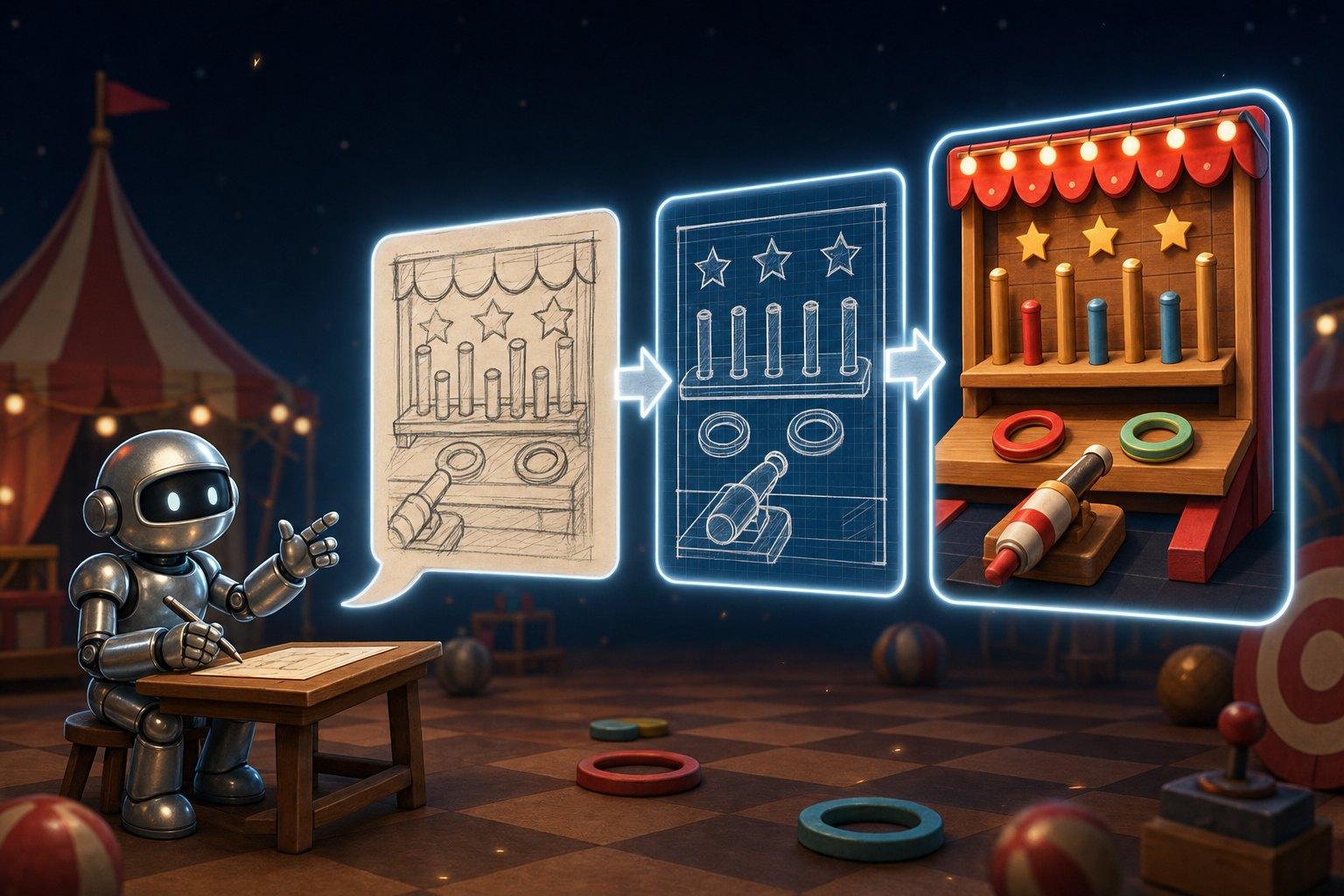
You tell Staky what you want in a sentence or two: "a haunted corridor where each door hides a ghost", "a slot machine built around our mascot", "a potion that gets stronger with each ingredient until it explodes". Attach your logo, characters or reference art, and Staky uses them.
Approve the plan and the preview
Staky answers with a plan: what the player does, how a round plays, what it will look like, and a drawn preview. Every game made in Game Creator plays one of three round shapes:
- Pick a path: the player picks one option at each step, some options lose, each step survived multiplies the win, and the player can cash out after any step they survive. Door, tile and crossing games live here.
- Instant prize: one play draws one or more prizes from a published table, from small and common to rare and large. Slots, wheels, plinko-style drops.
- Push your luck: each draw multiplies everything won so far, up or down, until the player cashes out, a zero ends the round, or the last step is reached. Towers, card runs and mine-digging games live here.
Talking to Staky and planning are free. Drawings, including the preview, are charged as they are made, and each one shows its cost in the chat. The build shows its price before you start, is charged only when you approve it, and is refunded if it fails.
The build, with a playtest
Staky hands the approved plan to its build agent, which writes the game and plays it. Before it ships, every game is loaded on desktop and phone and made to take a move. The build agent also plays it, through a win, a loss and a cash-out where the game has one, and checks what a player would notice: a scene too dark to read, an ending that barely changes the picture, the interface covering the action, errors on load. A game that cannot take a move, or fails to load the way it will ship, is refused and sent back.
Most builds take about 20–30 minutes; a heavy one can take longer. We are working to make that shorter.
Test it, then change it in plain words
You can test-play it for free, then publish your platform when you are happy. If you want something different later ("make it night-time", "slow down the reveal", "add a fourth door"), you ask, and Staky builds a new version. A small change takes about 5–10 minutes; a large one can take 20. A change keeps the old version live while it builds, then replaces it automatically, and you can restore any earlier version.
Teams with their own developers can ask us about uploading a game as a single HTML file instead. It plays under the same rules and passes the same automated file checks. It does not get the playtest a Game Creator build gets, so test it yourself before you publish. The step-by-step guide to the studio is How the Studio Works.
The comparison that matters: a studio title takes months and a studio budget. A Game Creator original takes an afternoon and a build price shown before you start. They are different products, and the second lets you keep adding new games in your own brand.
5. The engine owns the math
This is the decision that makes everything else possible.
The house edge and the payout table are set by the engine, not the AI. When Staky plans an Instant prize or Push your luck game, the engine fits the prizes and their chances, and it checks every prize table against the configured return to player (RTP) before a round can start. The AI cannot change it. The default house edge is 5%, a 95% return to player. It is set per token, and platforms that offer token play show it in their About panel. RTP is a theoretical return calculated over many plays; individual results vary.
The game cannot decide the result. In normal operation the engine commits to a secret and mixes in public blockchain randomness when the round is created, and it decides every real-money result on its own server. The stake, the odds, the outcome and the payout stay with the engine. A game cannot place a bet, set an amount or decide a result. It can only send the player's moves, such as a pick, a draw or, in some round types, settling or banking, and the engine checks each one. A game can still look wrong or display something badly, but what is paid follows the engine's result.
A round can be checked after it ends. When a round ends its secret is revealed, and the verify page lets you check it. While proofs are on, the seed's derivation is also submitted for on-chain verification; see how the fairness checks work. Lootbox draws use their own commit-and-reveal with blockchain randomness, and a box's owner can recheck its draw in the browser with one click on Verify draw.
We considered two other designs and rejected both. Letting the AI write the round logic would have given it more freedom and given operators nothing they could stand behind. Putting AI art on a few fixed templates would have been instant and predictable, and would have produced the same game thirty thousand times. Fixing the math in the engine and freeing everything the player sees is the narrow path between them.
One caveat applies to every provably fair casino: verification shows whether a round ran as committed. It does not change the house edge, which still applies.
6. Superstake: where it runs today
Superstake is a real-money casino, and it is where Game Creator, the engagement layer and our payment stack run today. New features are proven in live operation there before we offer them to other casinos.
The engagement layer. A new game earns attention for a week. What builds a lasting relationship with players is the system around the games. Superstake runs all of it, and our team switches these on for your platform:
- Quests, including quests for one operator's players only, with rewards in points, tokens or credit.
- Leaderboards per game, per operator and across the network, plus date-bounded competitions, and prize pots to fund them.
- Lootboxes with published drop tables and draws their owners can recheck.
- Streaks and levels: rewards for returning players.
- Points that come from real-money play and quests. Players can use them in a mode with no cash stake, and they can also open lootboxes.
- Referral codes set up by our team, which can give new players a locked starting balance, subject to your terms.
The industry evidence on missions is vendor-reported and compares players who chose to take part with those who did not, so read it as direction rather than proof. It still points one way. Across five operators, players who completed missions produced 150–600% more GGR each and showed 57–240% higher 30-day retention [22]; at operator level, revenue per player rose by up to 124% and 30-day retention by up to 40% as more players took up missions [23].
Payments and reach. New EVM chains can be added with a contract deployment and no new game code, and Solana and TON are supported. Players do not need to hold a platform's token first: deposits from other chains can be swapped into USD credit, and where card top-ups are enabled, players can buy credit by card and never touch a wallet. In credit play the engine drives each transaction end to end, so the player signs nothing and pays no network fee. Games run on the web and inside Telegram and Startale mini-apps; Telegram alone passed 1 billion monthly users in March 2025 [24].
On-chain stakes and payouts. On-chain play keeps the stake in a smart contract, and the payout is released from it against a result signed by the engine. That addresses a gap provable fairness alone leaves open: whether a win reaches the player. The round itself is played off-chain, and the contract relies on that signature rather than recomputing the result.
7. Three ways to work with SuperEngine
Self-serve today: launch a branded platform
Use Game Customizer and Game Creator to launch your own platform at its own address on Superstake, with your name, logo, colours, socials and games. It plays in USD credit by default, and the same platform can be listed on the Superstake hub, where players browsing the network find it. How to Launch Your Own Real Money Game Platform walks through it.
With our team today: go further on your platform
A dedicated subdomain with your brand across the header and login is set up with our team. Our team also switches on the engagement layer, the payment routes and the mini-apps described above, and sets up a different token if you need one.
We can open a studio for your community, so its creators make games for your platform and earn a share of each game's profit. That turns a community into a content team paid when its games perform.
In development: plug the full engine into the casino you already run
The full engine is being designed so integration follows the familiar provider pattern. None of this is live yet. The plan is:
- A game catalog: one feed of the games on the engine, with the metadata and art a lobby needs.
- A launch link: each game opens from a signed link inside your own site.
- Your own wallet: bets and payouts settle against your existing balances, through the usual debit, credit and cancel calls. The bankroll stays yours.
- Hosted game servers: SuperEngine runs the rounds. Neither you nor the game maker runs a server.
- Free bets and bonuses through the same kind of API you already use, with bonus rounds checked the same way as paid ones.
- Bring your games: we are building migration tools to move existing games onto the engine's standard contract.
Later stages aim to let a maker publish a game once and offer it to every casino on the engine, and to reduce the trust a casino has to place in us: sealed hardware that keeps round secrets and signs results, casinos holding their own keys, and on-chain bankrolls. The roadmap has the stages.
8. How SuperEngine compares
| Traditional studio | Aggregator | White label / turnkey | Template AI slot makers | Developer platforms | SuperEngine today | |
|---|---|---|---|---|---|---|
| Time to a new game | 3–12 months | Instant, but not yours | Instant, same catalogue | Seconds to minutes | Weeks of developer time | Most builds about 20–30 minutes after a chat |
| Cost per new game | About $30,000–120,000 | Supplier share plus aggregator margin | Setup fee plus revenue share | Near zero | Developer salaries | Build price shown before you start; platform profit is shared |
| Exclusive to you | If commissioned | No | No | A reskin of a shared template | Yes, if you build it | Made for your brand; exclusivity per your agreement |
| Who sets the odds | The studio's math team | The supplier | The supplier | The platform | The developer, then a reviewer | The engine, checked against the configured return |
| Variety of play | High | High | High | Low | High | Three round shapes in Game Creator, open-ended look and theme |
| Engagement layer included | No | No | Varies | No | No | Quests, leaderboards, pots, lootboxes, streaks and levels, set up with our team |
For reference, one vendor's comparison puts white-label launch at one to three months and turnkey at three to six [25].
9. What it does not do yet
- The plug-in integration is not live. Today a casino uses SuperEngine by launching a branded platform on Superstake. Connecting the full engine to your existing lobby and wallet comes later, and migration tools for existing games are still being built.
- Your brand does not replace ours everywhere. A self-serve platform sits at an address on Superstake, under the Superstake header. On a dedicated subdomain, Superstake's name can still appear in places such as the browser tab, share text and emails.
- Much of the setup goes through our team. Tokens, quests, prize pots, community studios, Telegram and card top-ups are not self-serve controls yet.
- Minutes, not seconds. Template tools answer in seconds because they generate only art. A bespoke game usually takes 20–30 minutes of build time, and a heavy one takes longer.
- Pure-chance formats only. Every Game Creator game is one of three round shapes, and the result is always decided by the draw. Skill can decide which option a player commits to, never whether it wins. There is no poker room or sportsbook here.
- Operators are responsible for the licences and rules in their own markets, and real-money play is for adults where lawful.
- Fairness checks have limits. If public blockchain randomness is switched off or unavailable when a round is created, the round uses a seed from our server instead. On-chain proofs cover how the seed was derived, not the outcome or payout, and a proof can fail to complete. For Instant prize rounds, the verify page confirms the prize table was fixed before the round, but it does not re-draw the result.
- Automated checks, not a person on every game. Game Creator relies on automated checks and the engine-owned math rather than a human review of each game. How much of the playtest a build completes can vary, and a finished change goes live without a separate approval step.
10. A first week with our team
Days 1 and 2 are self-serve. The rest is set up with our team.
- Day 1, self-serve: launch your branded platform with ready-made games such as crash and claw machine, in your name, logo and colours.
- Day 2, self-serve: describe your first original to Staky, built around your mascot or brand story. Test-play it, change it and publish it.
- Day 3, with our team: choose your token if you need one, and add a quest and a weekly competition with a prize pot around that game.
- Day 4, with our team: open a studio to your community and let its creators pitch the next games.
- Day 5, with our team: put the platform inside your Telegram channel or mini-app, and turn on card top-ups for players who do not hold crypto.
FAQ
What is the difference between SuperEngine and Superstake?
SuperEngine is our product family: Game Creator and Game Customizer today, and the full engine in development. Superstake is a casino where Game Creator, the engagement layer and our payment stack run today, and where new features are proven in live operation before we offer them to other casinos.
Is an AI-made game really fair?
Fairness does not depend on the AI. In normal operation the engine decides every result from a secret it commits to and from public blockchain randomness. The game can send the player's moves but cannot decide the result. When a round ends its secret is revealed, and the verify page lets you check it. The house edge still applies.
Who sets the RTP?
The engine. It checks every prize table against the configured return before a round can start. The default house edge is 5%, a 95% return to player, set per token. RTP is calculated over many plays, and individual results vary. The AI or a creator changes how a game looks and feels, not what it pays.
How long does it take?
The plan and preview come back in a short conversation. Most builds take about 20–30 minutes, including the automated checks, and a heavy one can take longer. A small change to a live game takes about 5–10 minutes; a large one can take 20.
What does it cost?
A branded platform has no setup fee and no per-seat cost. You earn a weekly share of your platform's net profit, after referral and points costs. The share is capped against volume, and a losing week reduces it. In the studio, talking to Staky and planning are free, drawings show their cost in the chat as they are made, and a build or a change shows its price before you start. For the plug-in integration, talk to us.
Can my own developers build games?
Yes, ask us about uploads. A game can be uploaded as one HTML file that talks to our game kit. It plays under the same rules and passes the same automated file checks, but it does not get the Game Creator playtest, so test it yourself before you publish.
Which chains and apps?
New EVM chains can be added with a contract deployment, and Solana and TON are supported, on the web and inside Telegram and Startale mini-apps. Our team switches on card top-ups and the mini-apps for your platform, and credit play needs no signature or network fee from the player.
Do players need crypto?
No. Where card top-ups are enabled, players can buy USD credit by card. Players can also use points in a mode with no cash stake. Points come from real-money play and quests, and can also open lootboxes.
Can I see what is already running?
Yes: browse live games and channels, or see the SuperEngine catalog.
Sources
- H2 Gambling Capital, Global gambling market to exceed $1 trillion GGR by 2030, 30 April 2026.
- Gambling Insider, Crypto Casino Investigation: How Big (or Small) is the Industry?, 2026. Higher headline estimates for 2024 are unaudited.
- SCCG Research, The Border Toll, July 2026, using on-chain deposit data for 23 casinos tracked by Tanzanite. Deposits are not GGR.
- UK Gambling Commission statistics for 2023–24, via iGaming Expert, 2025.
- Supplier figures via European Gaming: bets a minute and operators, August 2025, and monthly players, June 2026. Company-reported.
- Eilers & Fantini Online Game Performance, 2025 excerpt via iGaming Expert.
- Source Code Lab, Slot game development costs in 2026. Vendor estimate.
- Track360, Casino game providers, aggregators and operator integration, 2026. Vendor overview.
- Eilers & Fantini, Europe Online Game Performance Report, October–November 2025.
- Eilers & Fantini, OGPD Data Insights 2Q25, August 2025.
- iGaming Expert, eGamingMonitor: The era of every man and his dog studio, October 2026.
- Q1 2025 shareholder letter, GlobeNewswire, 7 May 2025.
- Q2 2025 earnings call transcript, The Motley Fool, August 2025.
- Yogonet, 5 February 2026.
- iGaming Business, 15 September 2026. Company-reported.
- UNLV International Gaming Institute and KPMG, State of AI in Gaming 2026, April 2026.
- Gambling Insider, February 2026.
- GamesBeat, October 2026. Company-reported.
- iGaming Business, 30 December 2025, and Observer-Reporter, 1 February 2026.
- WebGameBench, arXiv preprint, 2026.
- iGaming Business, What makes a top-performing online casino game in 2026?, 17 April 2026.
- Player engagement: missions, 8 July 2026. Vendor-reported.
- Five European operators: gamification, 22 July 2026. Vendor-reported.
- The Block, March 2025.
- Track360, White label casino vs turnkey vs custom, 2026. Vendor comparison.
Our own figures (build times, round shapes, RTP, chains and mini-apps) come from Game Creator and Superstake as they run today, November 2026. What this article says about the full engine describes plans, not a live product.